Transforming a grimy driveway or weathered patio into a spotless outdoor space can feel like an overwhelming chore. Traditional pressure washing wands, while effective, often lead to inconsistent results and frustrating streaks, not to mention the significant time and effort involved. This is where the power duo of a robust pressure washer and a specialized surface cleaner attachment steps in. This guide will cut through the noise, helping you understand the essential synergy between these tools and empowering you to select the best combination to achieve professional-grade results with remarkable efficiency and less fatigue.
Understanding Pressure Washers and Surface Cleaners
A pressure washer is a high-pressure mechanical sprayer used to remove loose paint, mold, grime, dust, mud, and dirt from surfaces and objects. By forcing water through a small nozzle at extremely high velocity, it delivers a powerful cleaning jet far superior to a garden hose. These versatile machines come in various forms, from compact electric models ideal for light household tasks to heavy-duty gas-powered units designed for commercial applications.
A surface cleaner attachment, often disc-shaped, revolutionizes the way you clean flat areas. Unlike a concentrated wand spray, a surface cleaner houses one or more rapidly spinning nozzles beneath its hood. These jets rotate consistently across the surface, providing a wide, even cleaning path. This ingenious design prevents the zebra-stripe effect common with a wand, covers ground significantly faster, and minimizes overspray, keeping you and surrounding areas drier. From large concrete driveways to delicate wooden decks and brick patios, a quality surface cleaner attachment can cut cleaning time by 60% or more, delivering uniform, streak-free results.
The evolution of pressure washing dates back to the mid-20th century, with initial applications primarily industrial. Over decades, advancements in pump technology and engine design made these powerful cleaners accessible for consumer use. The introduction of specialized attachments, such as the surface cleaner, further expanded their utility, allowing for targeted, efficient cleaning of specific surfaces. Today, pressure washers are indispensable for a multitude of outdoor cleaning tasks, from revitalizing vehicles and fences to deep cleaning sidewalks and large commercial floors.
Choosing the Right Pressure Washer and Surface Cleaner
Selecting the ideal pressure washer and its accompanying surface cleaner attachment requires a careful evaluation of your specific needs and a clear understanding of key technical specifications. Making the right choice ensures optimal performance, efficiency, and longevity for your equipment.
Determine Your Cleaning Needs
Before diving into specifications, consider what you’ll be cleaning and how often. Are you tackling small residential patios and driveways a few times a year, or do you have expansive commercial properties requiring frequent, heavy-duty cleaning? Your primary purpose—be it general home maintenance, vehicle washing, or extensive construction cleanup—will dictate the necessary power and durability. Furthermore, establishing a realistic budget is crucial, as costs can vary widely depending on power, features, and brand.
Key Factors to Consider
Several critical factors influence the effectiveness of a pressure washer and its surface cleaner pairing.
-
Pressure (PSI) and Flow Rate (GPM): These are the two most important metrics. PSI (Pounds per Square Inch) indicates the force of the water jet, while GPM (Gallons Per Minute) measures the volume of water delivered.
- Light-duty tasks (1500-2000 PSI, 1.2-1.6 GPM): Suitable for smaller electric pressure washers and 10-12 inch surface cleaners for cleaning patio furniture, grills, or small decks.
- Medium-duty tasks (2000-2800 PSI, 1.4-2.0 GPM): Often handled by more powerful electric or entry-level gas pressure washers. Ideal for residential driveways, sidewalks, and siding, paired with 12-16 inch surface cleaners.
- Heavy-duty tasks (2800+ PSI, 2.0+ GPM): Typically requires robust gas pressure washers for large driveways, commercial spaces, stripping paint, or removing stubborn grime. These pair best with larger 16-28 inch commercial-grade surface cleaners.
It’s vital that your pressure washer’s PSI and GPM fall within the recommended range of your chosen surface cleaner for optimal performance and to prevent damage to either component.
-
Engine Type (Gas vs. Electric): The power source significantly impacts performance, portability, and maintenance.
- Gas Pressure Washers:
- Pros: Offer superior power (higher PSI and GPM), allowing for faster cleaning of large, tough surfaces. Provide unmatched mobility, as they are not tethered to an electrical outlet. Built for durability and extended use.
- Cons: Louder during operation, produce exhaust emissions (not suitable for enclosed spaces), require more maintenance (oil changes, fuel, spark plugs), and generally have a higher initial cost and ongoing fuel expense.
- Electric Pressure Washers:
- Pros: Significantly quieter, produce zero emissions (safe for indoor or poorly ventilated areas), require less maintenance, lighter and easier to store, and typically have a lower initial price point.
- Cons: Generally less powerful than gas models, making them better suited for lighter-duty tasks and smaller surface cleaners. Mobility is limited by the length of the power cord and proximity to an outlet.
- Cordless/Hybrid Pressure Washers: Offer a blend of portability and convenience, with battery power freeing you from cords. However, they come with runtime limitations and often have a higher price point for comparable power. They are excellent for quick clean-ups where power outlets are scarce.
- Gas Pressure Washers:
-
Size and Weight: Consider the physical footprint and weight of the unit, especially if storage space is limited or if you need to transport it frequently. Wheels and ergonomic handles are critical for maneuverability, particularly with heavier gas models.
-
Features for Surface Cleaning: Look for pressure washers with quick-connect fittings (typically 1/4-inch) for easy attachment changes. The durability of the pump and hose is also crucial for prolonged surface cleaning tasks. For the surface cleaner itself, features like a splash guard skirt reduce overspray, while non-marring swivel wheels enhance maneuverability and reduce user fatigue, especially on larger models. Construction materials like stainless steel or durable, corrosion-resistant plastic indicate quality and longevity.
-
Brands and Reviews: Reputable brands for pressure washers such as Simpson, Ryobi, Greenworks, Westinghouse, and Stihl often offer reliable performance. For surface cleaners, brands like Karcher, Simpson, Whisper Wash, and BE Whirl-A-Way are consistently well-regarded. Always read user reviews and comparison guides to gauge real-world performance and reliability.
Pressure Washer and Surface Cleaner Combinations by Price Segment
While full pressure washer bundles explicitly including a surface cleaner are less common, you can build effective combinations by understanding the typical capabilities of machines within different price points and pairing them with appropriate attachments.
Entry-Level (Under $300)
This segment primarily features electric pressure washers, offering sufficient power for basic residential cleaning.
- Pressure Washer Characteristics: Typically 1500-2200 PSI and 1.2-1.6 GPM. Lightweight, compact, and easy to store.
- Surface Cleaner Pairing: Best paired with smaller 10-12 inch surface cleaner attachments designed for electric units. These are suitable for cleaning small patios, steps, garage floors, and short driveways.
- Advantages: Very affordable, quiet, low maintenance, and environmentally friendly.
- Disadvantages: Limited power for very stubborn stains or large areas, and mobility restricted by power cord.
- Example Combo: An electric pressure washer like the Sun Joe 2030 Max with a Karcher 11-inch surface cleaner (ensure connector compatibility).
Mid-Range ($300-$600)
This segment offers a mix of more powerful electric models and entry-level to mid-range gas pressure washers, suitable for more frequent use and larger residential tasks.
- Pressure Washer Characteristics: Electric models may reach 2300-3000 PSI with 1.4-2.0 GPM. Gas models start around 2500-3000 PSI with 2.0-2.5 GPM, often with reliable engines.
- Surface Cleaner Pairing: Can effectively use 14-16 inch surface cleaners. Gas units in this range can handle more robust attachments. This combination is ideal for cleaning average-sized driveways, larger patios, and pool decks.
- Advantages: Good balance of power and affordability, increased efficiency over entry-level options. Gas models offer greater mobility.
- Disadvantages: Gas models introduce noise, emissions, and more maintenance.
- Example Combo: A Ryobi 3000 PSI electric pressure washer (e.g., RY143011) or a Westinghouse WPX2700 gas model paired with a Simpson Universal 15-inch surface cleaner.
High-End/Professional (Over $600)
Designed for heavy-duty, frequent, and commercial cleaning, this category features powerful gas pressure washers.
- Pressure Washer Characteristics: Typically 3000-4200+ PSI with 2.5-4.0+ GPM, often featuring durable Honda engines and robust triplex pumps.
- Surface Cleaner Pairing: Best matched with larger 18-28 inch commercial-grade surface cleaners, often made of stainless steel with wheels for easy navigation. These combinations are built to tackle extensive concrete surfaces, industrial floors, and hot water applications.
- Advantages: Unmatched cleaning power and speed for the largest and toughest jobs, superior durability, and often hot water compatibility.
- Disadvantages: Significantly higher cost, heavier and bulkier, very noisy, and require more substantial maintenance.
- Example Combo: A Simpson Powershot 4200 PSI gas pressure washer with a Whisper Wash Classic 19-inch or a Mosmatic FL-AER surface cleaner.
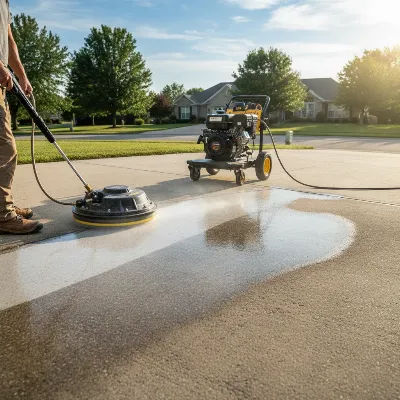 A powerful gas pressure washer connected to a wide surface cleaner attachment, effortlessly cleaning a large concrete driveway.
Top Picks: Recommended Pressure Washers & Surface Cleaner Pairings
Choosing the right pressure washer and a compatible surface cleaner can dramatically improve your outdoor cleaning efficiency. Here are some top recommendations, tailored for different needs.
Best Overall Gas Pressure Washer for Surface Cleaning: Simpson Powershot PS4240 (4200 PSI, 4.0 GPM)
The Simpson Powershot PS4240 is a beast designed for the most demanding surface cleaning jobs. Equipped with a reliable Honda GX390 engine and an industrial-grade AAA triplex pump, it delivers an impressive 4200 PSI and 4.0 GPM. This powerhouse is ideal for large driveways, commercial properties, and tackling deeply embedded grime. Its robust frame and large pneumatic tires ensure excellent maneuverability.
- Pros: Exceptional power and flow rate, commercial-grade components, Honda engine reliability, durable construction.
- Cons: High price, heavy, noisy, requires significant maintenance.
- Ideal Surface Cleaner Pairing: A 20-inch or larger professional-grade surface cleaner, such as the Simpson Universal 20″ Industrial Surface Cleaner or a Whisper Wash Classic 19″. The higher PSI/GPM of the PS4240 will maximize the efficiency and cleaning width of these larger attachments.
Best Overall Electric Pressure Washer for Residential Surface Cleaning: Greenworks Pro Brushless 3000 PSI
For homeowners seeking robust power without the fuss of gas, the Greenworks Pro Brushless 3000 PSI electric pressure washer is an outstanding choice. It delivers a solid 3000 PSI and 2.0 GPM, powered by an efficient brushless motor that offers extended life and quieter operation compared to many electric units. Its compact design and easy startup make it perfect for residential driveways, patios, and decks.
- Pros: Strong power for an electric model, quieter operation, zero emissions, low maintenance, easy to start and store.
- Cons: Tethered to an outlet, less mobile than gas, might take longer on very large or heavily soiled areas compared to high-end gas models.
- Ideal Surface Cleaner Pairing: A 14-15 inch residential surface cleaner, such as the Karcher 15″ Universal Surface Cleaner or the RYOBI 15 in. 3300 PSI Surface Cleaner. These sizes perfectly balance the Greenworks’ power for streak-free cleaning on typical home surfaces.
Best Portable/Cordless Option: EGO 56V 3200 PSI HPW3200
The EGO 56V 3200 PSI HPW3200 stands out for its impressive cordless power, offering 3200 PSI and 1.2 GPM using two 56V batteries. This model provides the ultimate freedom from cords and gasoline, making it perfect for areas without easy access to power outlets or for quick clean-ups where maximum mobility is desired. It’s an innovative solution that bridges the gap between traditional electric and gas models.
- Pros: Cordless freedom, surprisingly powerful for a battery unit, relatively quiet, easy startup.
- Cons: Battery runtime limitations (especially at highest power), higher initial cost due to battery and charger inclusion, lower GPM means slightly slower cleaning than high-end gas.
- Ideal Surface Cleaner Pairing: A 12-15 inch electric-compatible surface cleaner. While its GPM is lower, the decent PSI makes it capable of effective cleaning with attachments like the RYOBI 12 in. 2,300 PSI Electric Pressure Washers Surface Cleaner, ensuring even, portable cleaning.
Comparison Table: Pressure Washers for Surface Cleaning
| Feature | Simpson Powershot PS4240 | Greenworks Pro Brushless 3000 PSI | EGO 56V 3200 PSI HPW3200 |
|---|---|---|---|
| Power (PSI) | 4200 PSI | 3000 PSI | 3200 PSI |
| Flow Rate (GPM) | 4.0 GPM | 2.0 GPM | 1.2 GPM |
| Engine Type | Gas (Honda GX390) | Electric (Brushless) | Cordless (56V Battery) |
| Recommended SC Size | 18-28 inch | 14-16 inch | 12-15 inch |
| Best Use | Commercial, large, heavy-duty projects | Residential, medium-duty tasks | Portable, remote residential use |
| Noise Level | High | Medium-Low | Medium |
| Emissions | Yes | No | No |
| Mobility | High (no cord) | Medium (cord-dependent) | High (cordless) |
| Maintenance | High | Low | Low |
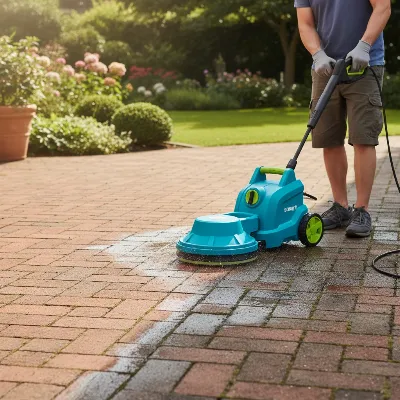 An electric pressure washer with a surface cleaner attachment cleaning a residential patio, with a clear contrast between clean and dirty areas.
Usage and Maintenance Guide for Pressure Washers and Surface Cleaners
Effective use and diligent maintenance are key to maximizing the performance and extending the lifespan of your pressure washer and surface cleaner attachments. Safety should always be your top priority.
How to Use a Pressure Washer and Surface Cleaner Safely
Always prioritize safety. Wear appropriate personal protective equipment (PPE), including safety goggles, gloves, and sturdy closed-toe shoes. High-pressure water can cause serious injury. Never point the spray at people, pets, or electrical outlets. Before starting, inspect all hoses, connections, and nozzles for damage. Ensure all connections are secure and the work area is clear of obstacles or anything that could be damaged by the high-pressure spray. Keep children and pets away from the operating area.
To set up your machine, connect the garden hose to the pressure washer’s inlet and the high-pressure hose to the outlet. Attach the surface cleaner to the end of your pressure washer wand using the quick-connect fitting, ensuring it clicks firmly into place. If you have an electric model, plug it into a grounded outlet. For gas models, fill the fuel tank and check the oil level. Turn on the water supply fully before starting the engine or motor to prevent damage to the pump.
When cleaning, use slow, overlapping passes with the surface cleaner to ensure even coverage and prevent streaking. Avoid lifting the cleaner off the surface while the water is flowing, as this can cause concentrated spray patterns. For stubborn spots, make additional passes or use a detergent with your pressure washer’s soap tank or dispenser, then rinse thoroughly.
Cleaning and Maintenance for Longevity
Proper care after each use and routine maintenance are crucial. After every cleaning session, disconnect the surface cleaner and rinse it thoroughly with clean water to remove any dirt or detergent residue. Run clean water through the pressure washer itself for a few minutes to flush out any chemicals or debris from the pump and lines.
Regular maintenance for your pressure washer includes checking and cleaning the water inlet filter screen, which can prevent debris from entering and damaging the pump. For gas models, this also means regular oil changes, spark plug checks, and air filter cleaning as per the manufacturer’s recommendations. In colder climates, winterizing your pressure washer by draining all water and adding pump protector solution is essential to prevent freezing and damage.
Common issues like streaking can often be resolved by checking your surface cleaner nozzles for clogs and ensuring you’re making consistent, overlapping passes. If your pressure washer experiences a loss of pressure, check for kinks in the hose, a dirty inlet filter, or an inadequate water supply. Consulting your owner’s manual for specific troubleshooting steps is always recommended. Storing your pressure washer and surface cleaner in a dry, protected area will prevent rust and prolong their life.
Conclusion
Choosing the best pressure washer with a suitable surface cleaner attachment is a game-changer for maintaining pristine outdoor spaces. By understanding the interplay of PSI, GPM, and engine type, you can confidently select a combination that perfectly aligns with your cleaning demands, whether for light residential touch-ups or heavy-duty commercial operations. Investing in the right tools and committing to proper usage and maintenance will not only deliver exceptional, streak-free results but also save you invaluable time and effort. Elevate your cleaning routine and discover the satisfaction of a truly pristine clean. What will be the first surface you tackle with your powerful new setup?
Frequently Asked Questions
What PSI is recommended for surface cleaning?
For effective surface cleaning, residential users typically need a pressure washer with at least 2000-2800 PSI. For larger areas or tougher grime, 3000-4000+ PSI found in gas models is ideal to power wider, more efficient surface cleaners. The PSI of your pressure washer must match the recommended PSI range of your surface cleaner attachment.
Can I use any surface cleaner with my pressure washer?
No, compatibility is key. Surface cleaners are rated for specific PSI and GPM ranges. Your pressure washer’s output must fall within these ranges. Additionally, most surface cleaners use a 1/4-inch quick-connect fitting, but some electric pressure washer brands (like Karcher) may use proprietary connectors, requiring specific branded attachments or adapters.
How much faster is a surface cleaner than a regular wand?
A surface cleaner can clean flat surfaces significantly faster, often reducing cleaning time by 4 to 10 times compared to a standard pressure washer wand. Its wide cleaning path and rotating nozzles cover a larger area more efficiently and consistently, preventing the need for multiple passes to avoid streaks.
Are surface cleaners worth it?
Absolutely. For anyone regularly cleaning large flat surfaces like driveways, patios, or sidewalks, a surface cleaner attachment is a worthwhile investment. It provides a more uniform, streak-free clean, dramatically reduces cleaning time, minimizes operator fatigue, and decreases water consumption compared to using a narrow wand.
How often should I clean my driveway with a pressure washer?
The frequency depends on your local environment and how quickly dirt, mold, and stains accumulate. Generally, most homeowners benefit from cleaning their driveway with a pressure washer and surface cleaner once or twice a year to maintain its appearance and prevent long-term buildup. More frequent cleaning might be needed in humid climates or areas with heavy traffic.
Get our weekly buyer guide
Practical specs, not advice. Unsubscribe anytime.
