Tackling stubborn grime, mildew, and dirt around your home can feel like an uphill battle, especially when a garden hose just isn’t cutting it. Whether you’re sprucing up a weathered deck, washing a mud-caked car, or restoring the sparkle to your concrete driveway, a reliable pressure washer is an indispensable tool. But with a sea of options on the market, choosing the right one can be daunting. Enter the Greenworks Pro 3000 PSI electric pressure washer, a model often hailed as a game-changer in the residential cleaning arena. This comprehensive review delves into its performance, features, and overall value, helping you decide if this powerful electric unit is the ultimate solution for your toughest outdoor cleaning challenges.
Overview of Pressure Washers
Pressure washers are powerful cleaning devices that use high-pressure water streams to remove loose paint, mold, grime, dust, mud, and dirt from surfaces and objects. From delicate vehicle washing to aggressive concrete cleaning, these versatile machines significantly cut down on cleaning time and effort. They come in various forms, primarily categorized by their power source and intended use.
The market generally features two main types: electric and gas-powered pressure washers. Electric models, like the Greenworks Pro 3000 PSI, are typically quieter, require less maintenance, and produce no exhaust fumes, making them ideal for residential tasks. Gas-powered units, while often more powerful and suitable for heavy-duty commercial or industrial applications, come with increased noise, maintenance demands, and emissions. The evolution of pressure washer technology has seen electric models close the performance gap, offering impressive power without the traditional drawbacks of gas engines.
Essential Buying Guide for Pressure Washers
Choosing the right pressure washer involves more than just picking the strongest model; it’s about matching the machine to your specific cleaning needs. Understanding key factors will ensure you invest in a tool that delivers both performance and value for years to come.
Determine Your Usage Needs
Before diving into specifications, consider what you’ll primarily be cleaning and how often. Are you looking to wash your car weekly, clean your patio furniture seasonally, or tackle extensive projects like siding and driveways? Your purpose dictates the necessary power and features. Frequent, heavy-duty cleaning might warrant a more robust machine, while occasional, lighter tasks could be handled by a less powerful, more compact unit. Also, establish a budget early on, as prices can vary significantly across different power levels and brands.
Critical Factors to Consider
Several technical specifications and features play a crucial role in a pressure washer’s effectiveness.
- Water Pressure (PSI): Pounds per Square Inch (PSI) measures the force of the water stream. Lower PSI (1500-1900) is suitable for light tasks like cleaning cars, grills, and patio furniture. Mid-range (2000-2800 PSI) handles decks, fences, and sidewalks. High-end models, like the Greenworks Pro 3000 PSI, offer 3000 PSI or more, making them effective for stripping paint, cleaning stubborn concrete, and tackling larger surfaces.
- Water Flow (GPM): Gallons Per Minute (GPM) indicates how much water the machine delivers per minute, directly impacting cleaning speed. A higher GPM means faster rinsing and cleaning, even if the PSI is similar. For instance, the Greenworks Pro 3000 PSI boasts up to 2.0 GPM at 100 PSI, with 1.1 GPM at its maximum 3000 PSI, balancing power with efficient water usage.
- Motor Type: Electric motors are quieter, produce no emissions, and require minimal maintenance, relying on an electrical outlet. Gas engines offer superior power and mobility but are louder, require fuel and oil changes, and ongoing maintenance. The Greenworks Pro 3000 PSI features an advanced TRUBRUSHLESS™ electric motor, which provides consistent power and durability often compared to gas models.
- Size and Weight: Consider where you’ll store the unit and how easily you need to move it. Lighter, more compact models are better for portability, while heavier units often indicate more powerful components. Features like never-flat wheels and vertical storage options (which the Greenworks Pro offers) can greatly enhance mobility and convenience.
- Additional Features: Look for useful accessories such as multiple quick-connect nozzles (e.g., 15°, 25°, 40°, soap, and turbo nozzles), onboard detergent tanks, and kink-resistant hoses. The Greenworks Pro 3000 PSI comes well-equipped with a full set of nozzles and a durable hose, making it versatile for various cleaning jobs.
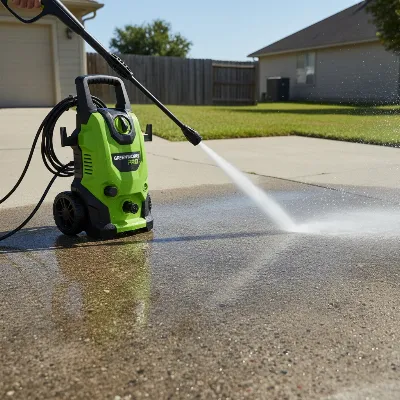 Greenworks Pro 3000 PSI Electric Pressure Washer in action
Reputable Brands and User Reviews
Researching reputable brands and reading user reviews are crucial steps. Established brands often offer better build quality, reliable performance, and robust customer support. Greenworks, Ryobi, Westinghouse, and Sun Joe are among the well-regarded names in the electric pressure washer market. User reviews provide real-world insights into a product’s strengths and weaknesses, helping you make an informed decision beyond marketing claims. Look for consistent feedback on durability, ease of use, and actual cleaning performance.
Pressure Washer Price Segments
Pressure washers are available across a spectrum of price points, catering to different budgets and cleaning requirements. Understanding these segments can help you set realistic expectations for performance and features.
Budget-Friendly Electric Pressure Washers (Typically Under $100 USD)
In this segment, you’ll find entry-level electric pressure washers designed for light-duty cleaning tasks. These units usually offer PSI ratings between 1500 and 1800, with GPM often around 1.0 to 1.2.
- Pros: Highly affordable, lightweight, easy to store, and perfect for occasional use on smaller surfaces. They are great for washing cars, patio furniture, and light dirt on sidewalks.
- Cons: Lower power means longer cleaning times for tougher jobs, and their components may not be as durable for frequent or heavy use.
- Typical Products: Smaller models from brands like Sun Joe or Karcher are common here, ideal for basic household cleaning without breaking the bank.
Mid-Range Electric Pressure Washers (Typically $100 – $250 USD)
This segment offers a significant step up in power and features, balancing cost with enhanced capability. These machines typically range from 1900 to 2500 PSI, with GPM between 1.2 and 1.6, making them versatile for a wider array of residential tasks.
- Pros: Good balance of power and price, capable of handling most household cleaning jobs efficiently, including decks, fences, driveways, and house siding. They often come with better accessories and improved build quality.
- Cons: Still not as powerful as high-end electric or gas models for the most demanding projects.
- Typical Products: Many Ryobi, Westinghouse, and larger Sun Joe models fall into this category, providing reliable performance for the average homeowner.
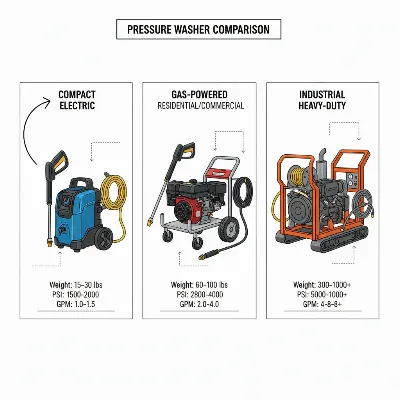 Various types of pressure washers: electric, gas, and industrial models contrasted
High-End Electric Pressure Washers (Typically Above $250 USD)
This is where powerful electric units like the Greenworks Pro 3000 PSI reside, often rivaling the performance of light to mid-duty gas pressure washers. These machines boast 2500 PSI and above, with GPM ratings often reaching 1.2 GPM at max pressure and higher at lower pressures.
- Pros: Exceptional cleaning power for an electric unit, capable of tackling heavy-duty tasks such as concrete restoration, paint prep, and extensive property cleaning. They typically feature robust brushless motors, durable components, and advanced features like smart sensing technology.
- Cons: Higher initial investment, can be heavier and bulkier than lower-end electric models.
- Typical Products: The Greenworks Pro 3000 PSI is a prime example of this segment, alongside top-tier models from EGO and certain high-spec Ryobi units, offering premium performance for discerning users.
Greenworks Pro 3000 PSI Electric Pressure Washer: A Deep Dive
The Greenworks Pro 3000 PSI electric pressure washer has carved out a reputation as one of the most powerful and feature-rich residential electric models available. Let’s explore what makes this machine a standout performer and where it might fall short.
Greenworks Pro 3000 PSI Pressure Washer: Performance and Features
The Greenworks Pro 3000 PSI lives up to its name, delivering substantial cleaning power that often surprises users accustomed to traditional electric units. While some independent tests have reported actual PSI readings around 2300-2600 PSI rather than a consistent 3000 PSI at the nozzle, it still generates an impressive cleaning force for an electric model, especially with its 1.1 GPM at max pressure and up to 2.0 GPM at lower pressures. This combination of PSI and GPM, often referred to as Cleaning Units (CU = PSI x GPM), places it among the top electric performers.
One of its most significant advantages is the TRUBRUSHLESS™ motor technology. This digitally controlled brushless motor automatically adjusts pressure and flow based on the nozzle being used, ensuring optimal cleaning power for any task. This intelligent design contributes to its efficiency and longevity, giving it a “gas-style” continuous run characteristic without the associated fumes or maintenance. Reviewers frequently praise its ability to effectively blast away stubborn dirt, mud, and grime from various surfaces, from sidewalks and patios to siding and vehicles.
The unit comes fully equipped with a suite of quick-connect nozzles (15°, 25°, 40°, soap, and turbo), offering versatility for different cleaning intensities. Onboard storage for these nozzles, along with a 25-foot kink-resistant steel-braided hose and a 35-foot power cord with GFCI, enhances usability and convenience. The 10-inch never-flat wheels and support for vertical storage also make it relatively easy to maneuver and store, despite its substantial weight (around 47-53 pounds).
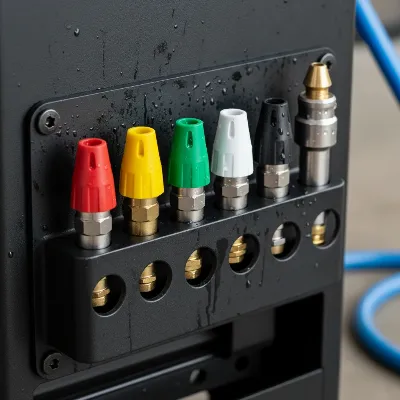 Close-up of pressure washer nozzles with different spray patterns
Pros:
- Exceptional Cleaning Power: Delivers near gas-like performance for an electric unit, effective on tough grime.
- TRUBRUSHLESS™ Motor: Smart sensing technology optimizes pressure and flow, enhancing efficiency and durability.
- Low Maintenance: No gas, oil, or spark plugs; just plug and play, significantly reducing upkeep compared to gas models.
- Quieter Operation: Significantly less noisy than gas pressure washers, allowing for conversations and less disturbance to neighbors.
- Comprehensive Nozzle Set: Includes a full range of nozzles for diverse cleaning tasks, with convenient onboard storage.
- Durable Build: Features like a steel-braided hose and robust motor contribute to its longevity.
- Excellent Warranty: Backed by a 3-year tool warranty and an impressive 10-year brushless motor warranty.
- Space-Saving Storage: Designed for vertical storage, saving up to 50% garage space.
Cons:
- Continuous Motor Operation: The motor runs continuously when powered on, even when the trigger isn’t pulled, which can be a minor annoyance for some, though it’s relatively quiet.
- Actual vs. Advertised PSI: While advertised at 3000 PSI, some real-world tests show slightly lower sustained pressure, though still very powerful for an electric unit.
- Weight: At around 47-53 pounds, it’s heavier than many other electric models, which might affect portability over uneven terrain.
- Plastic Wheels: While 10-inch and never-flat, some users prefer the grip and give of rubber tires.
- Occasional Gun Leak: Some reports mention the spray gun having minor leaks.
- Higher Price Point: As a premium electric model, its cost is higher than budget or mid-range alternatives.
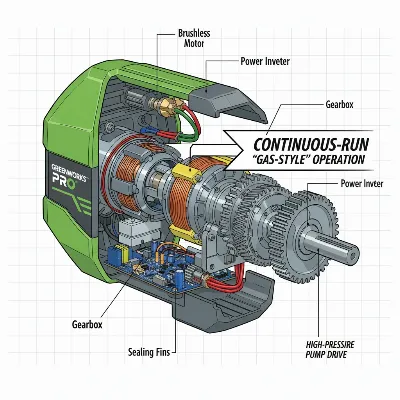 Greenworks Pro 3000 PSI showcasing its brushless motor and continuous operation
Who is it for?
The Greenworks Pro 3000 PSI is ideal for homeowners who need serious cleaning power for a wide range of tasks but want to avoid the hassle, noise, and maintenance of a gas-powered machine. It’s perfect for those with driveways, patios, siding, fences, cars, and other outdoor surfaces that require frequent or thorough cleaning. If you’re looking for a powerful, reliable, and relatively quiet electric alternative to gas, this model is a top contender.
Comparable Electric Pressure Washer Options
While the Greenworks Pro 3000 PSI stands out, other electric models offer strong competition:
- Ryobi 3000 PSI RY143011: Another powerful corded electric option, often praised for its robust performance and features, making it a direct competitor in the high-end electric segment.
- EGO 56V 3200 PSI Cordless (HPW3200): For those prioritizing cordless convenience without sacrificing power, EGO offers a very strong battery-powered model, though typically at an even higher price point.
- Westinghouse ePX3100 Electric Pressure Washer: A popular mid-range to high-end corded electric choice known for good power and value, though usually with slightly lower PSI than the Greenworks Pro 3000 PSI.
Comparison Table: Greenworks Pro 3000 PSI vs. Competitors
To put the Greenworks Pro 3000 PSI into perspective, let’s compare its key specifications with some notable electric competitors.
| Feature | Greenworks Pro 3000 PSI (GPW3000) | Ryobi 3000 PSI (RY143011) | Westinghouse ePX3100 |
|---|---|---|---|
| Max PSI (Advertised) | 3000 PSI | 3000 PSI | 2300 PSI |
| Max GPM (at 100 PSI) | 2.0 GPM | 2.3 GPM | 1.76 GPM |
| GPM (at Max PSI) | 1.1 GPM | 1.1 GPM | 1.2 GPM |
| Motor Type | TRUBRUSHLESS™ Electric | Brushless Electric | Brushless Electric |
| Hose Length | 25 ft (Steel-Braided) | 25 ft | 25 ft |
| Power Cord Length | 35 ft (GFCI) | 35 ft (GFCI) | 35 ft (GFCI) |
| Weight | ~47-53 lbs | ~50 lbs | ~40 lbs |
| Wheels | 10-inch Never-Flat Plastic | 12-inch Never-Flat | 10-inch Heavy-Duty |
| Special Features | Smart Sensing Motor, Vertical Storage, 10-yr Motor Warranty | Foldable Handle, Integrated Detergent Tank | Total Stop System (TSS), Pro-Style Wand |
| Price Range | High-End Electric | High-End Electric | Mid-High End Electric |
This table highlights that while many high-end electric pressure washers offer similar headline PSI figures, differences in GPM, motor technology, weight, and specific features can influence overall performance and user experience. The Greenworks Pro’s smart sensing motor and long motor warranty provide a distinct edge in durability and optimized cleaning.
Using and Maintaining Your Pressure Washer
To ensure your pressure washer performs optimally and lasts for years, proper usage and diligent maintenance are essential. This is especially true for powerful units like the Greenworks Pro 3000 PSI, where misuse can lead to damage or injury.
Safe Usage Guide
Operating a pressure washer requires adherence to safety protocols to prevent accidents.
- Personal Protective Equipment (PPE): Always wear safety glasses or goggles, closed-toe shoes, and gloves to protect against high-pressure water and flying debris. Hearing protection is also advisable, especially with gas models or extended use of electric units.
- Proper Connections: Ensure all hoses (garden hose to inlet, high-pressure hose to outlet, and spray gun) are securely connected before turning on the water and power. A loose connection can leak under high pressure.
- Water Supply: Always turn on the water supply fully before starting the pressure washer. Running the pump dry, even for a short period, can cause significant damage.
- Maintain Distance: Keep a safe distance from the surface you are cleaning, especially with higher PSI units. Start further away and move closer to avoid damaging delicate surfaces like wood or paint.
- Nozzle Selection: Use the correct nozzle for the job. Wider spray patterns (40°) are for general cleaning, while narrower patterns (15°, 0°) and turbo nozzles are for tough spots and should be used with extreme caution. The Greenworks Pro 3000 PSI includes various nozzles for different applications.
- Never Spray People or Animals: The high-pressure stream can cause serious injury. Always point the wand away from yourself and others.
- Electrical Safety: For electric models, ensure the power cord is in good condition, plug it into a GFCI-protected outlet, and keep connections dry.
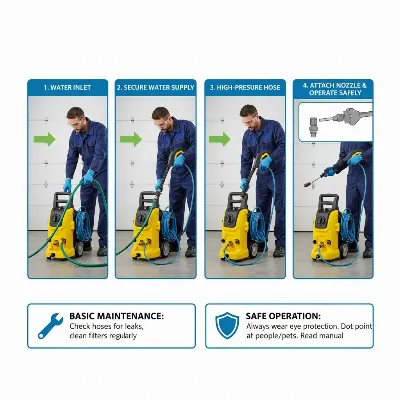 Person safely operating and maintaining a pressure washer
Cleaning and Maintenance Guide
Regular cleaning and maintenance extend the life and efficiency of your pressure washer.
- After Each Use:
- Flush the System: Disconnect the high-pressure hose and turn off the engine/motor. Squeeze the trigger to release any remaining pressure in the system. Then, disconnect the garden hose and run fresh water through the pump for a minute or two to flush out any detergent or chemical residues.
- Clean Nozzles: Remove nozzles and clear any debris with a small pin or nozzle cleaning tool.
- Wipe Down: Clean the exterior of the machine with a damp cloth to remove dirt and grime.
- Seasonal/Periodic Maintenance:
- Winterizing (for cold climates): If storing in freezing temperatures, it’s crucial to winterize your pressure washer to prevent damage from ice. This typically involves using a pump protector or antifreeze solution specifically designed for pressure washers.
- Check Hoses and Connections: Regularly inspect hoses for cracks, kinks, or leaks, and ensure all quick-connect fittings are free of debris and functioning correctly.
- Store Properly: Store your Greenworks Pro 3000 PSI in a dry, covered area, utilizing its vertical storage capability to save space.
Common Issues and Troubleshooting:
- No Pressure: Check water supply, ensure hoses are not kinked, verify proper nozzle selection, and ensure connections are tight. A clogged nozzle is a frequent culprit.
- Pulsating Pressure: This often indicates air in the system. Ensure all air is purged by squeezing the trigger with the water on and the motor off, then restart.
- Leaks: Inspect O-rings in connections; they might need to be replaced. For spray gun leaks, consult the manufacturer’s guide.
Following these guidelines will help you safely maximize the performance and longevity of your Greenworks Pro 3000 PSI pressure washer.
Conclusion
The Greenworks Pro 3000 PSI electric pressure washer truly stands out as a formidable cleaning machine, redefining expectations for what electric models can achieve. With its impressive cleaning power, intelligent TRUBRUSHLESS™ motor technology, and array of user-friendly features, it effectively bridges the gap between traditional electric convenience and gas-like performance. While it carries a higher price tag and a few minor quirks like continuous motor operation, its low maintenance requirements, quieter performance, and robust build quality, backed by an exceptional 10-year motor warranty, offer significant long-term value. For homeowners seeking a powerful, reliable, and environmentally friendlier alternative to gas pressure washers, the Greenworks Pro 3000 PSI is a top-tier investment. Ready to transform your outdoor cleaning routine?
Frequently Asked Questions
Is 3000 PSI too much for home use?
No, 3000 PSI is generally not too much for home use, especially for tougher jobs like cleaning concrete driveways, heavy-duty siding, or stubborn stains. However, it’s crucial to use the correct nozzle and maintain an appropriate distance from the surface to avoid damage, particularly on more delicate materials.
Can the Greenworks Pro 3000 PSI clean mold off siding?
Yes, the Greenworks Pro 3000 PSI is highly effective at cleaning mold and mildew off siding. For best results, use a wide-angle nozzle (e.g., 40-degree or soap nozzle with detergent) and maintain a safe distance to prevent damage to the siding material.
What is the difference between PSI and GPM in pressure washers?
PSI (Pounds per Square Inch) measures the force or intensity of the water stream, indicating cleaning power. GPM (Gallons Per Minute) measures the volume of water flow, which impacts how quickly you can rinse away dirt. Both are crucial, as higher PSI tackles tough stains, and higher GPM speeds up the cleaning process.
Does the Greenworks Pro 3000 PSI have an auto shut-off feature?
No, the Greenworks Pro 3000 PSI features a continuous-run motor, similar to gas pressure washers. This means the motor will run consistently while the unit is powered on, even when the trigger is not engaged. While it doesn’t have an auto shut-off, its operation is notably quieter than most gas models.
How often should I perform maintenance on my electric pressure washer?
For electric pressure washers like the Greenworks Pro 3000 PSI, minimal maintenance is required. It’s recommended to flush the system with clean water after each use to remove detergent residue. If storing in freezing temperatures, winterize the pump annually with a pump protector solution to prevent damage.
Can I use any detergent with the Greenworks Pro 3000 PSI?
You should only use detergents specifically designed for pressure washers. Regular household detergents can damage the pump and internal components of the pressure washer. The Greenworks Pro 3000 PSI has an integrated soap tank, making it easy to apply pressure washer-safe cleaning solutions.
Get our weekly buyer guide
Practical specs, not advice. Unsubscribe anytime.
