In the demanding world of commercial cleaning, where stubborn grime, expansive surfaces, and relentless usage are the norm, a standard pressure washer simply won’t cut it. Businesses from construction and fleet maintenance to industrial facilities and property management require robust, reliable, and powerful machines capable of delivering consistent, heavy-duty performance. Choosing the right commercial pressure washer is paramount to efficiency, cost-effectiveness, and achieving truly pristine results. This comprehensive guide, crafted from over a decade of hands-on experience, will navigate you through the critical features, top models, and essential maintenance practices to help you select and optimize the perfect heavy-duty cleaning solution for your commercial needs.
Understanding Commercial Pressure Washers
Commercial pressure washers are engineered for a league above residential models, built to withstand continuous use and tackle the most challenging cleaning tasks. At their core, these machines force water through a high-pressure pump, ejecting it through a nozzle at intense speeds to blast away dirt, grease, paint, and other stubborn contaminants. They are indispensable across a myriad of industries, from deep-cleaning construction equipment and sanitizing industrial facilities to restoring building exteriors and preparing surfaces for painting.
Modern commercial units typically come in two main types based on water temperature: cold water and hot water. Cold water pressure washers are versatile and effective for general dirt and grime, while hot water units excel at dissolving grease, oil, and caked-on residue more rapidly, often with less or no detergent. Power sources generally include gasoline engines for maximum mobility in outdoor environments and electric motors for quieter, emission-free operation in indoor or noise-sensitive areas. Key components like industrial-grade pumps (direct drive or belt drive) and durable frames are designed for longevity and resilience in harsh working conditions. Over time, these machines have evolved to offer greater efficiency, portability, and specialized features, making heavy-duty cleaning more accessible and effective than ever before.
Comprehensive Buying Guide: Selecting Your Heavy-Duty Pressure Washer
Choosing the ideal commercial pressure washer requires a strategic assessment of your specific operational demands. Investing in the wrong machine can lead to inefficiencies, breakdowns, and unsatisfactory cleaning outcomes.
Assessing Your Cleaning Demands
Before diving into specifications, consider the precise nature of your work. Are you primarily removing caked-on mud from construction vehicles, stripping old paint from concrete, sanitizing food processing equipment, or clearing graffiti? The purpose will dictate the required power and features. Equally important is the frequency of use; a machine used daily for several hours will need superior durability and higher-grade components than one used weekly. Finally, establish a realistic budget, recognizing that a higher upfront investment often translates to greater longevity, fewer repairs, and superior performance in the long run.
Critical Features to Evaluate
The performance of a commercial pressure washer hinges on several key specifications and design choices.
-
Pressure (PSI) and Flow Rate (GPM): These are the twin pillars of cleaning power. Pounds Per Square Inch (PSI) measures the force of the water stream, while Gallons Per Minute (GPM) indicates the volume of water delivered. For heavy-duty commercial tasks, look for machines offering 3000 PSI and above, often reaching 4000 PSI or even higher for industrial applications. A higher GPM (typically 3.0 GPM or more) allows for faster rinsing and wider coverage, significantly reducing cleaning time, especially on large surfaces. A balanced combination of high PSI and GPM provides optimal cleaning efficiency.
-
Power Source: Gas vs. Electric:
- Gas-powered units are the workhorses for outdoor, heavy-duty tasks. They offer superior power (often 3000-4000+ PSI) and unmatched mobility, ideal for remote job sites like construction zones, agricultural farms, or large commercial properties where electrical outlets are scarce. Engines from reputable brands like Honda are common in high-end models. However, they are louder, produce emissions, and require fuel and more routine engine maintenance.
- Electric-powered units are preferred for indoor applications, noise-sensitive environments, or areas with strict emission regulations. While generally less powerful than their gas counterparts for the heaviest tasks (though some commercial electric models can reach 3000 PSI), they are quieter, produce no fumes, and require less engine maintenance. They are excellent for tasks like cleaning industrial kitchens, food processing plants, or vehicle interiors where a power outlet is readily available.
-
Pump Type: Direct Drive vs. Belt Drive: The pump is the heart of your pressure washer.
- Direct drive pumps are directly coupled to the engine, making the unit more compact, lighter, and generally less expensive. They operate at higher RPMs, which can lead to faster wear with prolonged, heavy use.
- Belt drive pumps use a belt and pulley system to connect the engine to the pump, allowing the pump to operate at lower RPMs. This reduces heat, vibration, and wear on the pump, significantly extending its lifespan. While belt drive units are typically larger, heavier, and more costly, their enhanced durability makes them the preferred choice for truly heavy-duty, continuous commercial applications.
-
Water Temperature: Cold vs. Hot Water Units:
- Cold water pressure washers are versatile and cost-effective, ideal for removing general dirt, mud, and loose debris. They are sufficient for many heavy-duty tasks, especially when paired with appropriate detergents.
- Hot water pressure washers are a game-changer for breaking down and dissolving grease, oil, sap, and other sticky, caked-on residues. The heated water dramatically improves cleaning speed and effectiveness, often reducing or eliminating the need for strong chemicals. This makes them indispensable for industries like automotive, heavy machinery, food service, and industrial manufacturing, though they come with a higher purchase price and more complex maintenance requirements.
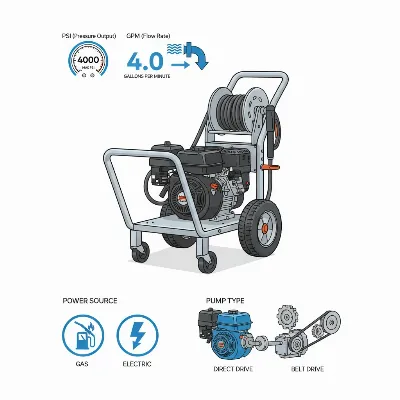 A detailed infographic illustrating key features of a heavy-duty commercial pressure washer with labels for PSI, GPM, power source, and pump type.
-
Durability and Construction: Commercial use demands robust construction. Look for machines with welded steel frames, heavy-duty tires (often pneumatic for rough terrain), and industrial-grade components like ceramic plungers in the pump. Stainless steel or brass fittings are indicators of quality and resistance to corrosion. The overall build should feel solid and capable of withstanding bumps, drops, and continuous operation in demanding environments.
-
Portability and Ergonomics: Even heavy-duty machines need to be maneuverable. Consider the weight, wheel size, and frame design for ease of transport around job sites. Features like ergonomic handles, vibration-dampening mounts, and balanced weight distribution contribute to user comfort and reduced fatigue during long cleaning sessions.
-
Accessories and Nozzles: A range of quick-connect nozzles is crucial for versatility. Different spray patterns (0-degree for concentrated blasting, 15-degree for stripping, 25-degree for general cleaning, 40-degree for delicate surfaces, and a soap nozzle) allow you to adapt to various tasks. Additional accessories like turbo nozzles for increased impact, rotating brushes, surface cleaners, and chemical injectors can significantly enhance functionality and efficiency.
Leading Brands and User Reviews
Reputation matters in commercial-grade equipment. Brands like Simpson, Pressure-Pro, Landa, Karcher Commercial, and BE are widely recognized for their durable, high-performance commercial pressure washers. Always delve into user reviews and expert comparisons. Real-world feedback often highlights the longevity, reliability, ease of maintenance, and customer support aspects that specifications alone might not reveal. Pay attention to reviews from professionals in similar industries to yours for the most relevant insights.
Commercial Pressure Washer Pricing Segments
The investment in a heavy-duty commercial pressure washer can vary significantly based on its power, features, and build quality. Understanding these segments helps in budgeting and matching the machine to your specific business needs.
Entry-Level Commercial (Typically Under $2,000)
This segment includes machines that offer a significant upgrade from residential models but are often direct-drive, cold-water units with PSIs ranging from 2500 to 3500 and GPMs around 2.5-3.0.
- Advantages: More affordable, good for businesses just starting out, or for lighter heavy-duty tasks like small fleet washing, residential concrete cleaning for contractors, or routine property maintenance.
- Disadvantages: May have shorter lifespans under continuous, rigorous use compared to higher-tier models due to direct-drive pumps and less robust components. They typically lack hot water capabilities.
- Example: Some professional-grade gas pressure washers from brands like Simpson in the 3000-3500 PSI range.
Mid-Range Commercial ($2,000 – $5,000)
This is where you find a balance of power, durability, and features for a wide array of demanding tasks. Many belt-drive, cold-water units fall into this category, with PSIs from 3500 to 4000 and GPMs of 3.0-4.0.
- Advantages: Enhanced durability with belt-drive pumps, higher PSI and GPM for faster, more effective cleaning, and a wider range of applications. They are built for more consistent use.
- Disadvantages: Higher initial cost than entry-level units. Hot water options are generally not available in this price point for truly commercial-grade units.
- Example: Pressure-Pro Professional 4000 PSI Belt-Drive Gas Pressure Washer, Simpson PowerShot series with Honda engines and belt-drive pumps.
Premium & Industrial-Grade (Over $5,000)
This segment represents the pinnacle of commercial pressure washing technology, designed for the most extreme and continuous industrial applications. These often include hot water units, very high PSI (4000+), and GPM (4.0+), advanced pump systems, and superior construction.
- Advantages: Unmatched cleaning power, exceptional durability, hot water capabilities for tackling the toughest grease and grime, professional-grade features for efficiency and safety, and long operational lifespans.
- Disadvantages: Significant initial investment and potentially higher maintenance costs due to more complex systems (especially with hot water heaters). These units can also be larger and heavier.
- Example: Landa MHC4-35324E, BE 4,000 PSI Hot Water Pressure Washer, or advanced skid-mounted Pressure-Pro units.
Top Picks: Best Heavy-Duty Commercial Pressure Washers
Based on performance, durability, and suitability for heavy-duty commercial tasks, here are some top contenders that consistently receive high marks from professionals.
Simpson PS4240 PowerShot 4200 PSI Gas Pressure Washer
The Simpson PS4240 PowerShot is a true powerhouse, often lauded for its robust performance and reliability in demanding environments.
- Advantages: Boasts 4200 PSI and 4.0 GPM, powered by a Honda GX390 engine, making it excellent for stripping paint, cleaning large driveways, or preparing commercial buildings. Its industrial triplex plunger pump is designed for longevity, and the welded steel frame with pneumatic tires enhances durability and portability across rough terrain.
- Disadvantages: It’s a heavy unit, which can make loading and unloading challenging. Being gas-powered, it produces exhaust and noise, limiting its use to outdoor settings.
- Ideal User: Contractors, property managers, and cleaning professionals requiring exceptional power and flow for frequent, extensive outdoor cleaning jobs, particularly those involving tough grime and large areas.
Pressure-Pro Professional 4000 PSI Belt-Drive Gas Pressure Washer
For those prioritizing pump longevity and consistent performance under heavy loads, Pressure-Pro’s belt-drive models are a standout.
- Advantages: Delivers 4000 PSI and features a durable Honda engine paired with a General Pump belt-drive system. The belt-drive significantly extends pump life by reducing heat and vibration, making it ideal for prolonged daily use. Its robust construction ensures it can handle the rigors of commercial job sites.
- Disadvantages: Like other gas models, it’s noisy and generates emissions. The belt-drive system adds to the unit’s size and weight, potentially impacting maneuverability in tight spaces.
- Ideal User: Professionals seeking maximum pump durability and a machine built for continuous, heavy-duty operation in outdoor industrial or commercial cleaning applications where extended run times are common.
Landa MHC4-35324E Hot Water Pressure Washer
When the toughest grease and grime are the challenge, a hot water unit like the Landa MHC4-35324E becomes indispensable.
- Advantages: This unit is specifically designed for industrial-grade tasks that demand hot water’s superior cleaning capability. It excels at breaking down oils, fats, and deeply embedded contaminants, reducing chemical usage and speeding up cleaning times. Landa is known for its rugged, heavy-duty construction, ensuring reliability in the most punishing environments.
- Disadvantages: As a premium industrial hot water unit, it has a considerably higher price point and requires more complex maintenance than cold water models due to the heating coil and burner system. It’s also large and heavy.
- Ideal User: Industrial facilities, automotive shops, food processing plants, or anyone dealing with significant amounts of grease, oil, or sticky residues where hot water is essential for effective and efficient cleaning.
Karcher Commercial Electric HDS 3.0/20 C Ea (or similar powerful electric unit)
For environments that require powerful cleaning without the noise and emissions of gas, Karcher offers robust electric commercial options. (Note: Specific Karcher model may vary by region and year, focusing on a strong electric commercial unit).
- Advantages: Provides significant pressure (often around 2000-3000 PSI, potentially higher for some models) suitable for many heavy-duty tasks indoors. It’s quiet, emission-free, and generally requires less maintenance than gas engines. Ideal for use in warehouses, commercial kitchens, manufacturing plants, or other enclosed spaces.
- Disadvantages: Requires access to appropriate electrical outlets (often 230V or higher for powerful models), which can limit mobility. Generally has less raw power and flow than top-tier gas units.
- Ideal User: Businesses needing powerful, quiet, and fume-free cleaning for indoor facilities, commercial kitchens, food processing, or any area sensitive to noise and emissions, with readily available power access.
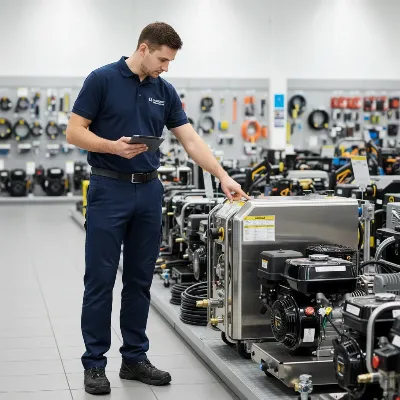 A professional selecting a heavy-duty commercial pressure washer from a range of models in a store, focusing on specifications.
Comparative Analysis: Key Commercial Pressure Washer Models
Here’s a comparison of typical heavy-duty commercial pressure washer specifications. Please note that “Estimated Price Range” can fluctuate based on dealer, promotions, and specific configurations.
| Feature / Model | Simpson PS4240 PowerShot | Pressure-Pro Pro 4000 PSI Belt-Drive | Landa MHC4-35324E (Hot Water) | Karcher Commercial HDS (Electric, high-end) |
|---|---|---|---|---|
| Pressure (PSI) | 4200 | 4000 | 3500-4000+ | 2000-3000+ |
| Flow Rate (GPM) | 4.0 | 3.0-4.0 | 3.0-4.0+ | 2.0-3.0 |
| Power Source | Gas (Honda GX390) | Gas (Honda Engine) | Gas (Heating) / Electric (Pump) | Electric |
| Pump Type | Triplex Plunger (Direct-ish) | Belt Drive (General Pump) | Belt Drive | Triplex Plunger |
| Max Water Temp | Cold | Cold | Up to 200-300°F | Cold (some Karcher models are hot water) |
| Key Features | Welded Steel Frame, Pneumatic Tires, Pro-Style Spray Gun | Industrial-Grade Pump, Reduced Wear, Durable Frame | Hot Water Capability, High Efficiency Burner, Robust Industrial Build | Quiet Operation, Emission-Free, Compact Design (for its power) |
| Ideal for | Large outdoor areas, paint stripping, construction sites | Continuous heavy-duty use, industrial environments | Extreme grease/oil removal, sanitization, rapid cleaning | Indoor industrial cleaning, noise/emission-sensitive areas |
| Estimated Price Range | $1,000 – $2,000 | $2,000 – $4,000 | $5,000 – $15,000+ | $2,000 – $6,000+ |
Safe Operation and Maintenance for Longevity
To maximize the lifespan and ensure safe, efficient performance from your heavy-duty commercial pressure washer, adherence to strict safety protocols and a diligent maintenance schedule is paramount.
Essential Safety Protocols
Operating a high-powered commercial pressure washer demands respect for its force. Always wear appropriate Personal Protective Equipment (PPE), including safety glasses, hearing protection, gloves, and sturdy, closed-toe footwear. Before starting, ensure the work area is clear of people, pets, and fragile objects. Never point the nozzle at anyone or any part of your body. Be aware of the powerful recoil when engaging the trigger and maintain a firm stance. For electric units, use GFCI-protected outlets and inspect cords for damage. For gas units, handle fuel in well-ventilated areas away from ignition sources. Familiarize yourself with the machine’s shut-off procedures and emergency stops.
> “Safety isn’t just a guideline with commercial pressure washers; it’s a non-negotiable principle. The sheer power can cause serious injury if not handled with absolute care.” – John Smith, Commercial Cleaning Safety Expert
Routine Care and Troubleshooting
A consistent maintenance regimen will prevent costly repairs and extend your machine’s life.
- After Each Use: Flush the pump with clean water to remove chemical residues. For gas units, ensure the engine cools before storage. Clean any debris from the air filter and exterior.
- Pump Maintenance: Regularly check and change the pump oil according to the manufacturer’s schedule (often every 50-100 hours of operation for new pumps, then every 200-300 hours). Inspect hoses and nozzles for wear or blockages.
- Engine Maintenance (Gas Units): Follow the engine manufacturer’s recommendations for oil changes, spark plug replacement, and air filter cleaning/replacement. Keep the fuel system clean and use fresh, stabilized fuel.
- Winterization: If storing in freezing temperatures, properly winterize your machine by running pump antifreeze through the system to prevent damage.
- Common Issues:
- Loss of Pressure: Check for clogged nozzles, kinks in the hose, insufficient water supply, or air in the pump.
- Engine Won’t Start (Gas): Verify fuel levels, spark plug condition, and air filter cleanliness.
- Leaking: Inspect O-rings, connections, and hoses for cracks or loose fittings.
For any complex issues or major repairs, always consult a qualified service technician. Attempting DIY repairs without expertise can lead to further damage or safety hazards.
Conclusion
Selecting the best heavy-duty commercial pressure washer is a critical decision that impacts your business’s efficiency, cleaning quality, and long-term operational costs. By thoroughly assessing your specific needs, understanding the crucial factors like PSI, GPM, power source, and pump type, and investing in a reputable brand, you equip yourself with a powerful tool capable of tackling the most demanding tasks. Remember that consistent safety practices and diligent maintenance are not merely recommendations, but essential commitments that ensure your equipment performs reliably for years to come. Invest wisely, maintain diligently, and unlock unparalleled cleaning power for your commercial operations. What challenging cleaning tasks will your next heavy-duty pressure washer conquer?
Frequently Asked Questions
What PSI and GPM are considered “heavy-duty” for commercial pressure washers?
For heavy-duty commercial tasks, a pressure washer should generally have at least 3000 PSI (Pounds Per Square Inch) and 3.0 GPM (Gallons Per Minute). Many industrial-grade units offer 4000 PSI or more with 4.0 GPM, providing even greater power and faster cleaning for the toughest applications.
Is a hot water commercial pressure washer always better than a cold water one for heavy-duty tasks?
Not always. While hot water pressure washers are superior for dissolving grease, oil, and sticky residues, cold water units are often sufficient and more cost-effective for general dirt, mud, and loose debris. The “better” choice depends on the specific type of heavy-duty contaminants you regularly face.
How often should I perform maintenance on a commercial pressure washer?
Maintenance frequency depends on usage. For commercial units, daily checks (hoses, nozzles) are recommended. Pump oil should typically be changed every 50-100 hours for initial break-in, then every 200-300 hours. Gas engines require regular oil changes, spark plug inspections, and air filter cleaning as per manufacturer guidelines, often more frequently than residential models due to heavier use.
Can I use a gas commercial pressure washer indoors?
No, gas-powered commercial pressure washers should never be used indoors or in poorly ventilated areas. They produce carbon monoxide, a colorless, odorless, and deadly gas. Electric commercial pressure washers are the appropriate choice for indoor cleaning applications due to their emission-free operation.
What’s the difference between direct drive and belt drive pumps in commercial units?
Direct drive pumps are directly connected to the engine, resulting in a more compact and lighter unit, but they run at higher RPMs and can wear out faster with continuous use. Belt drive pumps use a belt system, allowing the pump to operate at lower RPMs, which reduces heat, vibration, and wear, significantly extending the pump’s lifespan. Belt drive units are generally larger, heavier, and more durable for prolonged commercial applications.
Get our weekly buyer guide
Practical specs, not advice. Unsubscribe anytime.
